A brief downloadable history and description of the parish is available here.
Our present parish church, at 243 Jockey Road, Boldmere, was opened on March 10th 1953 by Archbishop Joseph Masterson with a High Mass sung by Monsignor Leonard Emery.
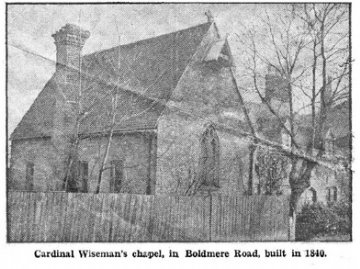
The name of the parish church remains that given to the first Catholic chapel built here in Boldmere. Permission was given in 1840 to build that chapel to serve the (then) rural community of Catholic farm labourers who made their home here.
The title of St Nicholas was given in honour of Nicholas Wiseman, Rector of Oscott College, who was to become England's first Post-Reformation Cardinal.
Saint Nicholas’ Chapel, was designed by Augustus Welby Pugin (a lecturer at Oscott College at the time), opened in 1841. It was one of the first Catholic churches to be built in the Birmingham district after the passing of the 1829 Catholic Emancipation Act.
Our present parish church, at 243 Jockey Road, Boldmere, was opened on March 10th 1953 by Archbishop Joseph Masterson with a High Mass sung by Monsignor Leonard Emery.
The name of the parish church remains that given to the first Catholic chapel built here in Boldmere. Permission was given in 1840 to build that chapel to serve the (then) rural community of Catholic farm labourers who made their home here.
The title of St Nicholas was given in honour of Nicholas Wiseman, Rector of Oscott College, who was to become England's first Post-Reformation Cardinal.
Saint Nicholas’ Chapel, was designed by Augustus Welby Pugin (a lecturer at Oscott College at the time), opened in 1841. It was one of the first Catholic churches to be built in the Birmingham district after the passing of the 1829 Catholic Emancipation Act.
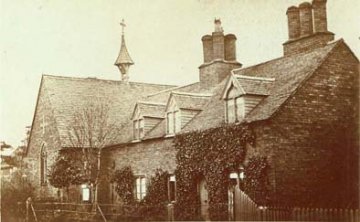 Original chapel and cottages for Priest and a carpenter
The Catholic community of Boldmere did not then have a resident priest, but was supplied first by priests from Oscott College, and later by Benedictine monks of Erdington Abbey (who made their home there, having been exiled from the German Abbey of Beuron). Among the eminent Catholic priests who celebrated Mass and preached in the tiny original chapel of St Nicholas were John Henry Newman, Blessed Dominic Barberi, and Cardinal Nicholas Wiseman. In 1922 the Beuronese Benedictines left Erdington in 1922. The parish of St Nicholas was again entrusted to the care of priests of Saint Mary’s College, Oscott .
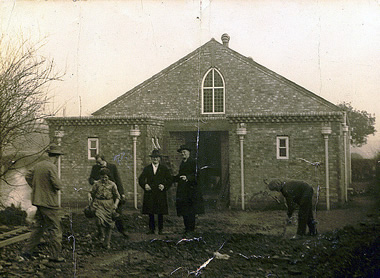 The second St Nicholas parish church, built in 1929
Boldmere had expanded and the chapel, seating 50, was too small. A second church called “The Institute”, costing £1,600, and funded by loans from the congregation, was opened on December 1st 1929. A sanctuary screen turned it into a hall and school.
In 1930 Dr. John Cregg became the first resident priest and lived in one of the two Pugin cottages attached to the original chapel (the other was let to a local carpenter). It was chilly and cramped and his dining room was also the sacristy and confessional. These dwellings were eventually condemned as being unfit for human habitation.
In February 1932 Dr Cregg moved to a house in Jockey Road that was separated from the second church by eight yards of privately owned land that was for sale for £125. Archbishop Williams approved purchase of the house and freehold land for £2,000, preventing a builder from cutting a road from Jockey Road to Gate Lane for a housing estate.
Dr. Cregg, distressed by the sinking of HMS Hood in World War II with no chaplain on board, volunteered and was accepted to serve as a Forces Chaplain. His place in the parish was taken by Father Basil Wrighton and then, in 1943, by Fr J. Denis McEvilly who took on the work of building the third (and to-date) last church built to serve the parish.
A local Catholic farmer, Robert Plant, left a legacy of £1,000 to build a church on condition that the foundation stone was laid within seven years of his death. In July 1951, with just one day left, Archbishop Masterson laid the foundation stone with a silver trowel, as the Papal flag flew over the site of the High altar. Estimated cost of £16,800 had risen to £18,500 when it was opened and blessed by Archbishop Masterson, on March 10th 1953.
The porch was added in 1957 with a gift of £5,000 from parishioner and former Mayor of Sutton Coldfield, Alderman William Lawley. Incorporated into the porch is the bell from the turret of Pugin's earlier chapel.
Father McEvilly died in 1981. The next parish priests were Fr Peter Dennison, Fr Petroc Howell, and Fr Brendan Carrick, who served as parish priest from 1989 - 2002. From 1998 to 2006 the parish had the services also of Father David Bazen (a married former Anglican minister who was ordained as a Catholic priest from this parish).
With generous help from Sutton Coldfield Municipal Charities, Father Brendan had the church decorated. A new font, pulpit, heating system, piety shop and toilets were added and the car park was resurfaced.
Work was progressing on the provision of a new meeting room, to be built behind the church, when Father Carrick was appointed, in 2002, to serve in Saint Patrick’s, Wolverhampton.
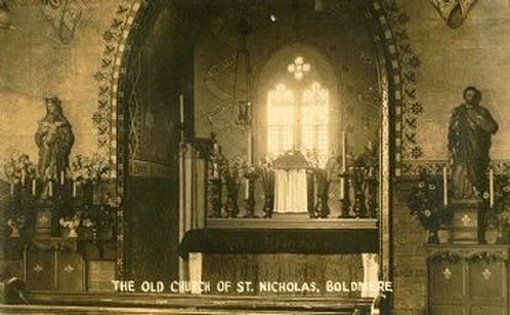
To his replacement, Fr Timothy Ford, fell the work of preparing for the celebration of the Golden Jubilee celebration of the present church. That Jubilee was celebrated in March 2003, with Archbishop Vincent Nichols celebrating the Jubilee Mass and blessing the new meeting room. The room was named the Benedict Room, (for the Benedictines of Beuron) and contains restored statues of Our Lady and of Saint Benedict from the parish's first chapel.
The Millennium year 2000 was marked by the planting of a Millenium Yew in the church grounds, and by the publication of The Bell, a parish magazine, still going strong over 15 years later.
Fr Ford retired from the parish in 2010 due to health reasons. Fr Van Tien Nguyen, originally from Vietnam, was appointed and welcomed as Parish Priest of Boldmere. In Summer 2011 a new multi-media centre and inter-active whiteboard were installed for use by the parish groups.
In 1930 Dr. John Cregg became the first resident priest and lived in one of the two Pugin cottages attached to the original chapel (the other was let to a local carpenter). It was chilly and cramped and his dining room was also the sacristy and confessional. These dwellings were eventually condemned as being unfit for human habitation.
In February 1932 Dr Cregg moved to a house in Jockey Road that was separated from the second church by eight yards of privately owned land that was for sale for £125. Archbishop Williams approved purchase of the house and freehold land for £2,000, preventing a builder from cutting a road from Jockey Road to Gate Lane for a housing estate.
Dr. Cregg, distressed by the sinking of HMS Hood in World War II with no chaplain on board, volunteered and was accepted to serve as a Forces Chaplain. His place in the parish was taken by Father Basil Wrighton and then, in 1943, by Fr J. Denis McEvilly who took on the work of building the third (and to-date) last church built to serve the parish.
A local Catholic farmer, Robert Plant, left a legacy of £1,000 to build a church on condition that the foundation stone was laid within seven years of his death. In July 1951, with just one day left, Archbishop Masterson laid the foundation stone with a silver trowel, as the Papal flag flew over the site of the High altar. Estimated cost of £16,800 had risen to £18,500 when it was opened and blessed by Archbishop Masterson, on March 10th 1953.
The porch was added in 1957 with a gift of £5,000 from parishioner and former Mayor of Sutton Coldfield, Alderman William Lawley. Incorporated into the porch is the bell from the turret of Pugin's earlier chapel.
Father McEvilly died in 1981. The next parish priests were Fr Peter Dennison, Fr Petroc Howell, and Fr Brendan Carrick, who served as parish priest from 1989 - 2002. From 1998 to 2006 the parish had the services also of Father David Bazen (a married former Anglican minister who was ordained as a Catholic priest from this parish).
With generous help from Sutton Coldfield Municipal Charities, Father Brendan had the church decorated. A new font, pulpit, heating system, piety shop and toilets were added and the car park was resurfaced.
Work was progressing on the provision of a new meeting room, to be built behind the church, when Father Carrick was appointed, in 2002, to serve in Saint Patrick’s, Wolverhampton.
To his replacement, Fr Timothy Ford, fell the work of preparing for the celebration of the Golden Jubilee celebration of the present church. That Jubilee was celebrated in March 2003, with Archbishop Vincent Nichols celebrating the Jubilee Mass and blessing the new meeting room. The room was named the Benedict Room, (for the Benedictines of Beuron) and contains restored statues of Our Lady and of Saint Benedict from the parish's first chapel.
The Millennium year 2000 was marked by the planting of a Millenium Yew in the church grounds, and by the publication of The Bell, a parish magazine, still going strong over 15 years later.
Fr Ford retired from the parish in 2010 due to health reasons. Fr Van Tien Nguyen, originally from Vietnam, was appointed and welcomed as Parish Priest of Boldmere. In Summer 2011 a new multi-media centre and inter-active whiteboard were installed for use by the parish groups.
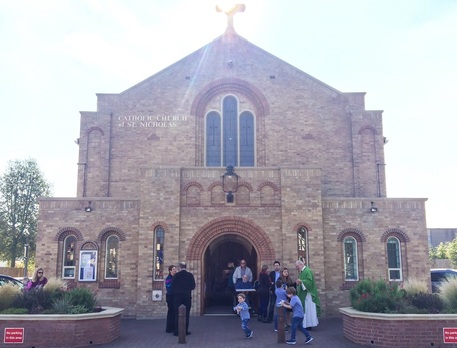
In 2013, the year of the Diamond Jubilee of the 3rd church, extensive renovation works were carried out to the porch brickwork and roof, and a new cross installed on the front elevation of the church. Together with redecoration and renovation of the interior of the church, these works were enabled by the generosity of the parishioners. Bishop Philip Pargeter presided at Mass to celebrate the parish church's Diamond Jubilee on the feast of Saint Nicholas, 6th December 2013.
In Summer 2015 Fr Van Nguyen began further studies in Rome, and the Archbishop appointed Fr Allen Morris, on loan from the Diocese of Westminster, to serve as Parish Priest in Boldmere and Chaplain at Bishop Walsh School.
In Summer 2015 Fr Van Nguyen began further studies in Rome, and the Archbishop appointed Fr Allen Morris, on loan from the Diocese of Westminster, to serve as Parish Priest in Boldmere and Chaplain at Bishop Walsh School.
Parish timeline
|
1840
1840 1841 1893 1922 1923 1926 1930 1941 1943 1951 1953 1957 1958 1961 1961 1968 1980 1981 1988 1989 1993 1994 1995 1998 1999 2000 2002 2002 2003 2006 2010 2013 2015 |
Nicholas Patrick Wiseman became Rector of Oscott College.
Bishop Thomas Walsh, after whom Bishop Walsh School is named, gave permission for a Catholic Chapel to be built in Boldmere. First chapel of St Nicholas, in Boldmere Road, opened, named after Nicholas Wiseman, who later became the first Post-Reformation Cardinal. First priests to serve at the chapel were Oscott professors and monks from the Benedictine Abbey, Erdington. Last burial in the graveyard by the chapel in Boldmere Road. October – Father Joseph Hogan of Oscott College became Priest-in-Charge of St. Nicholas’. Father Hogan was replaced by Father Paul van de Pitte, Professor of Philosophy at Oscott College. Reverend J. H. Faulconer-Morgan, Procurator of Oscott College, became Priest-in-Charge. On December 1st 1929 he said the first Mass in the second church of St Nicholas (known as “The Institute”). This later became the Church hall when the 3rd and present Church was built. (It is now leased to an evangelical Christian group for charitable and social work in Boldmere, and is known as the Carpenter’s Arms (a reference to the carpenter who lived in one of the two cottages attached to the original chapel, and of course to Our Lord Jesus Christ, and to the Sutton Park Pub that is adjacent to the site)). September 13th – Dr. John Cregg was appointed first resident Parish Priest. He lived in one of the little cottages attached to the first chapel, which was still in use for Mass during the week. Dr. Cregg became Forces Chaplain in World War II and was replaced by Father Basil Wrighton. Monsignor John Cregg died on January 15th 1961. Father J. Denis McEvilly was appointed to St. Nicholas’. July 5th – Foundation stone of third church of St. Nicholas laid by Archbishop Masterson. March 10th – Archbishop Masterson opened the new, third Church of St. Nicholas with high mass sung by Monsignor Leonard Emery of Oscott College. May – At Father McEvilly’s Silver Jubilee as a priest, Alderman Lawley, former Mayor of Sutton and parishioner for 50 years, gave £5,000 to add the porch to the church. November 27th – Archbishop Grimshaw blessed the extension at a Pontifical Mass. January 15th. Monsignor John Cregg died. The original Pugin chapel in Boldmere Road was demolished to make way for shops. A plaque on the shop wall marks the site. September 10th – St. Nicholas Primary School opened. May 22nd - Consecration of the church by Bishop Leo McCartie. Father J.D. McEvilly died. Father Peter Dennison appointed to St. Nicholas. Father Dennison retired because of ill health and was replaced by Father Petroc Howell. Father Dennison died on April 24th 1993. Father Brendan Carrick appointed as Parish Priest. St. Nicholas’ School began its Silver Jubilee Year. March 25th - a Silver Jubilee Tree was planted by the school door. On July 12th Bishop Brain said the Silver Jubilee Mass in the School Hall. May, Bishop Philip Pargeter said Mass for Father Brendan’s Silver Jubilee. February 14th - Parishioners attended the Ordination of Father David Bazen at St Chad’s Cathedral. On February 15th Father David celebrated his first Mass at St. Nicholas, followed by lunch for all parishioners. December, First edition of The Bell, a parish Magazine, to launch the Millennium. April 4th – A sapling from a 4,000-year-old Yew Tree, a gift from The Conservation Foundation, was planted in the presbytery garden to mark the Millennium. August 16th - Father Brendan Carrick moved to St. Patrick’s Church, Wolverhampton. A Parish farewell was held for him in October. August 17th – Father Timothy Ford was welcomed to Boldmere as Parish Priest. March 10th – The Golden Jubilee of the Third Church Of St. Nicholas. September – departure of Father David Bazen. Spring - Father Van Tien Nguyen, born in Vietnam, joined as Parish Priest following the retirement of Father Ford Renovations to the porch, front elevation and interior benches completed in time for the celebrations of the Diamond Jubilee of the Third Church Of St. Nicholas, with mass said by the Right Reverend Philip Pargeter. Fr Van Nguyen departed for Rome and St Nicholas' welcomed Fr Allen Morris as new Parish Priest. |
